Aldo Benini
Organizations of the poor
Back to Home page
The latest:
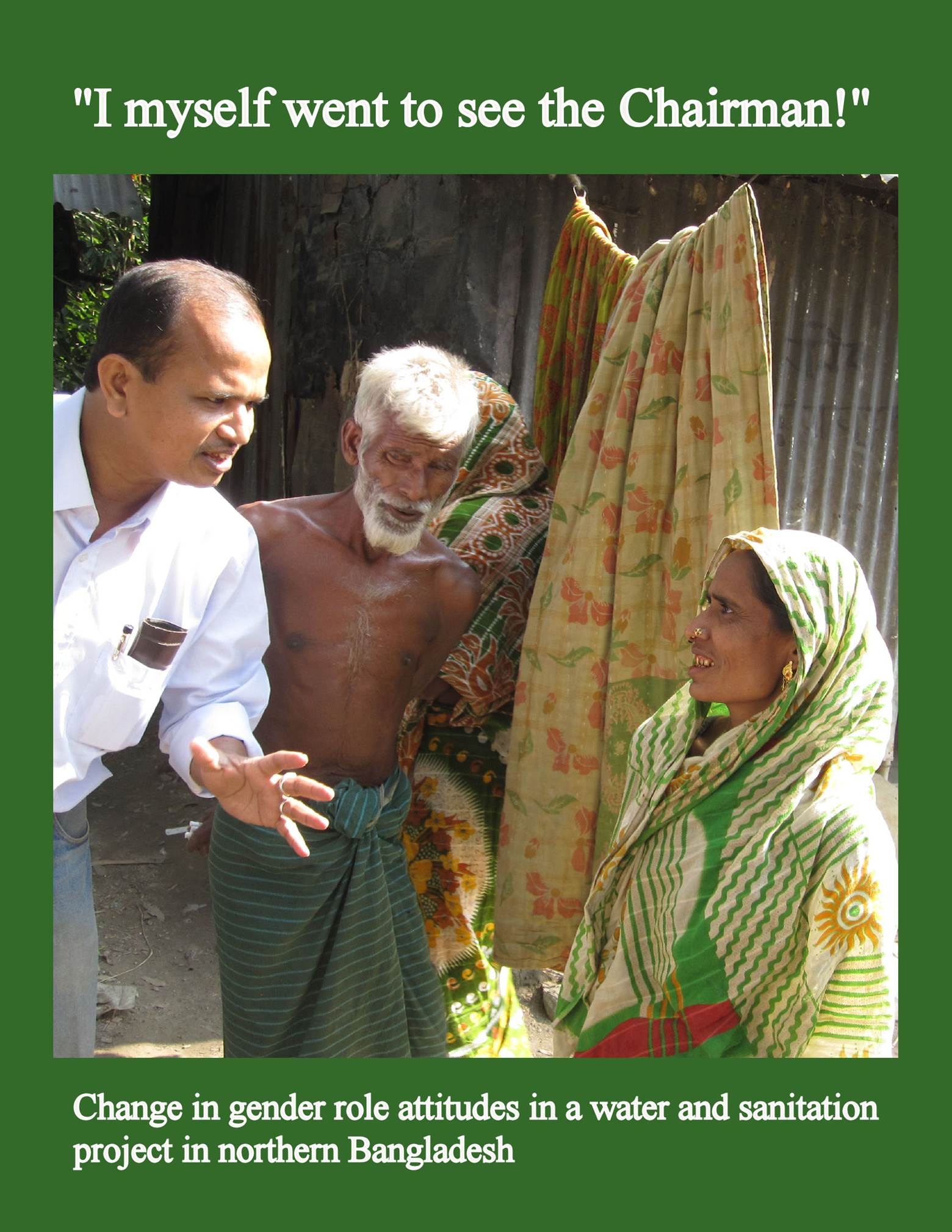
Monitoring systems occasionally incorporate elements of action research. A water and sanitation project in northern Bangladesh elaborated a Gender Analytic Framework to help organized public conversations on gender roles in household, village and local government. Trained volunteers facilitated sessions and recorded responses to 29 gender-related items in 988 villages during four years. "I myself went to see the Chairman!" (2014, together with several others) analyzes the change in gender role attitudes with the help of Rasch scales. The tool achieves two things: It provides a summary attitude measure out of a large heterogeneous material. It thus makes gender attitudes amenable to analysis in terms of community baseline attributes, WatSan project inputs and pre-existing local attitudes.
"Personal skills and social action" (2013, together with several others) is a sociological history of the 35-year effort, by Friends In Village Development Bangladesh (FIVDB), to create and amplify adult literacy training when major donors and leading NGOs had opted out of this sector. It is written in Amartya Sen's perspective that
"Illiteracy and innumeracy are forms of insecurity in themselves. Not to be able to read or write or count or communicate is itself a terrible deprivation. And if a person is thus reduced by illiteracy and innumeracy, we can not only see that the person is insecure to whom something terrible could happen, but more immediately, that to him or her, something terrible has actually happened".
The study leads the reader from theories of literacy and human development through adult literacy in Bangladesh and the expert role of FIVDB to the learners' experience and a concept of communicative competency that opens doors of opportunity. Apart from organizational history, the empirical research relied on biographic interviews with former learners and trainers, proportional piling to self-evaluate relevance and ability, analysis of test scores as well as village development budget simulations conducted with 33 Community Learning Center committees. A beautifully illustrated printed version is available from FIVDB.
Development NGOs are under increasing pressure to demonstrate impact. The methodological rigor of impact studies can challenge those with small research staffs and/or insufficient capacity to engage with outside researchers. "Reflections on research processes in a development NGO: FIVDB's survey in 2013 of the change in household conditions and of the effect of livelihood trainings" (2013, with several others) grapples with some related dilemmas. On one side, it is a detailed and careful account of how a qualitative methodology known as "Community-based Change Ranking" and data from previous baseline surveys were combined to derive an estimate of the livelihood training effect distinct from highly diverse changes in household conditions. In the process, over 9,000 specific verbal change statements were condensed into a succinct household typology. On the other side, the report discusses challenges that regularly arise from the study design to the dissemination of findings. The choice of an intuitive impact metric (as opposed to one that may seem the best in the eyes of the analyst) and the communication of uncertainty in the findings are particularly critical.
In "Poor areas, or only poor people?", Ravallion and Wodon (1999) demonstrated "significant and sizable geographic effects on living standards after controlling for a wide range of nongeographic characteristics of households" . Together with Reazul Karim and others (2013), I continue this line of investigation in "Poverty or Location?", a study of an area of 988 villages and hamlets in northern Bangladesh. We use three-level models (village, electoral ward and Union) of the effects of socio-economic and locational factors on water and sanitation outcomes and, for comparison, on access to post-primary education and to health care. We find that these effects vary by institutional domain, but that the question has to be rephrased as "poverty, location and institutions".
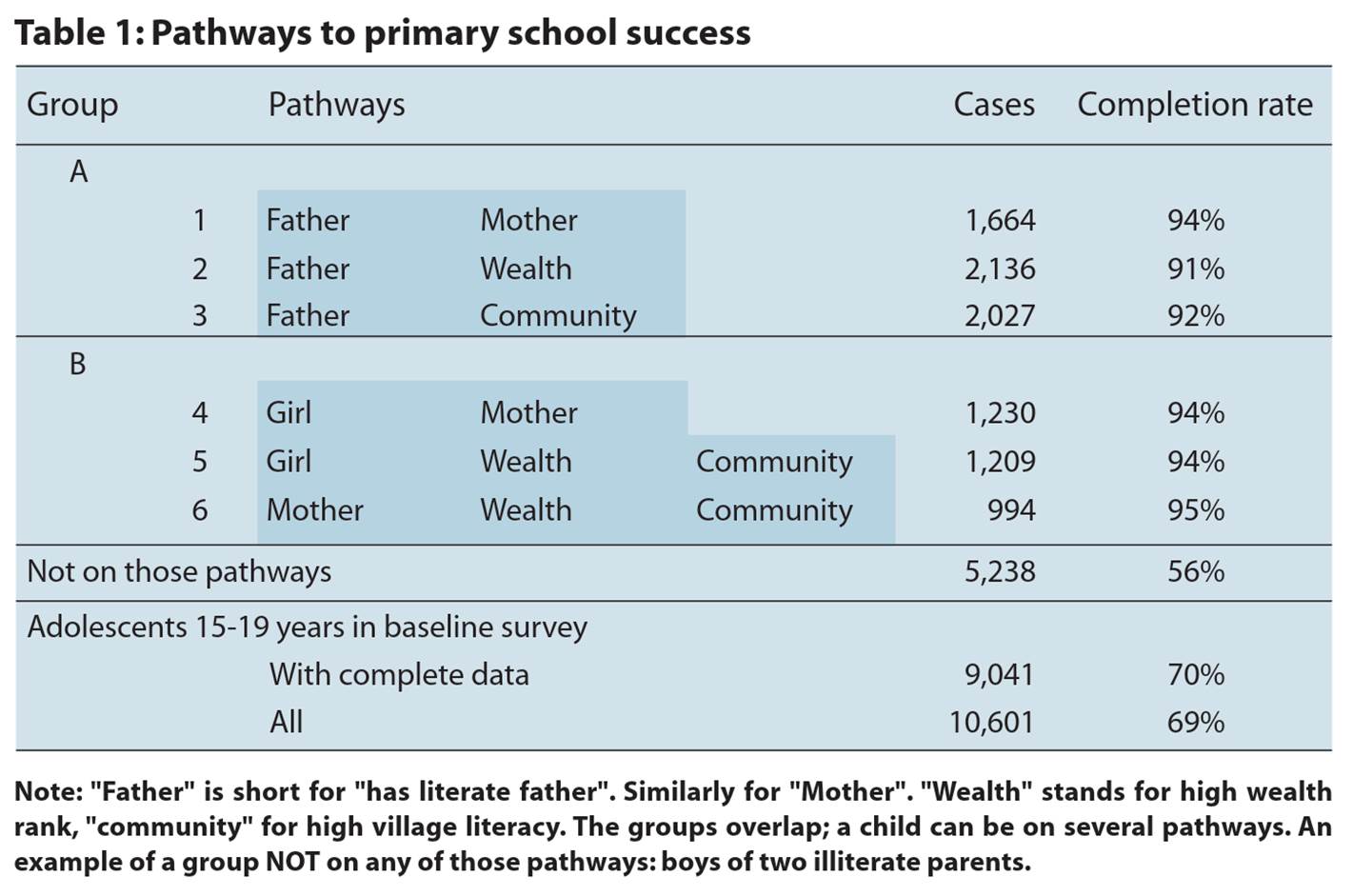
"It takes a village to put a child through school - Can community literacy substitute for parental literacy?" (2012, together with Wasima Samad Chowdhury) tests the relationship between parental literacy, community literacy rates and the primary school success of over 9,000 adolescents enumerated in a large village baseline survey in northeastern Bangladesh. It finds that chances to complete Primary Class V are very similar for children of illiterate parents in high-literacy villages and for those of two literate parents in low-literacy villages.
 We investigate the mechanisms through
which this substitution effect operates. Besides multi-level regression models,
we rely on case studies of students and their environment as well as on
Qualitative Comparative Analysis (QCA) (see table). We identify six pathways to
primary school completion. The literate environment always works together with
other enablers, such as being a girl student or from a wealthier household. In
high-literacy villages, children - also those of illiterate parents - find
resourceful supporters more easily. Anecdotically,
friendships with fellow students from better-off families help, not only in
studies, but also with school authorities. For school success, the substitution
between parental and community literacy is real, if mediated by other factors.
We investigate the mechanisms through
which this substitution effect operates. Besides multi-level regression models,
we rely on case studies of students and their environment as well as on
Qualitative Comparative Analysis (QCA) (see table). We identify six pathways to
primary school completion. The literate environment always works together with
other enablers, such as being a girl student or from a wealthier household. In
high-literacy villages, children - also those of illiterate parents - find
resourceful supporters more easily. Anecdotically,
friendships with fellow students from better-off families help, not only in
studies, but also with school authorities. For school success, the substitution
between parental and community literacy is real, if mediated by other factors.
Microfinance research has traditionally advanced in two directions. In an institutional perspective, the focus has been on the financial sustainability of the provider. Alternatively, the impact on the customers is observed, chiefly in terms of poverty reduction. "RDRS and the Poor: Microfinance as Partnership" bridges those perspectives. The study, by RDRS Bangladesh, evaluates the experience of a large, multisectoral development NGO, at a time when the philosophical and political climate for microfinance has grown harsher, and a nuanced viewpoint from the grassroots deserves to be heard.
We operationalize partnership in terms of the duration of the business relationship. Querying a large database of over 400,000 borrowers, with over 900,000 loans issued between 2004 and 2010, we model continuation, extent of and time to delinquency and default, and household wealth in 2010. They vary in response to loan history, borrower, borrower group, frontline worker, branch and period variables. Technically, most models are survival analyses and variants of Tobit regression.
Key findings are: the ability of the ultra-poor to repay, the fact that default is rare, but also the highly fluctuating nature of these customers. To the extent that we can observe it, they have indeed improved their economic position. Attribution of this effect to the program, however, is difficult.
This study was undertaken at the occasion of the 20th anniversary of the RDRS Bangladesh Microfinance Program in 2011 and in preparation for RDRS' 40th anniversary in February 2012.
I conducted this study together with Mozammel Haque, the microfinance database manager in the Rangpur coordination office, Paul von Bünau, of the Technical University of Berlin, and Bhabatosh Nath, with “Responsive to Integrated Development Services”, Dhaka. Supplemental materials detail the extraction queries, statistical models and where researcher may apply for a copy of the data.
Book-length:
“Does Empowerment Work?”
(2008) investigates the
effectiveness in poor rural societies of a concept of modernity that has
enjoyed an explosive career over the past fifty years - empowerment. From
rich-nation self-help movements to the liberation of historically oppressed
groups, programs claiming to give power to the powerless are legion. Often they
are mixed with other normative master frames and social technologies such as
human rights or micro-finance.
This study traces the origins,
growth and underlying assumptions of the empowerment philosophy. It gives a
detailed analysis of the structures, processes and outcomes of two large
programs affiliated with the Lutheran World Federation. Consonant with the
Federation's Global Strategy, the Cambodia and Tanzania programs pursue
empowerment, rights-based and integrated approaches on an equal footing. This
offers rich opportunities to observe synergies and contradictions among those
strategies and with their ambient societies.
Does empowerment work? Yes, at
least to the extent that the observed programs have carried out, in poor rural
communities and among some of their poorest households, an initial mobilization
focused on self-assertive and planned improvements. Will it persist in global
development discourse? This is more doubtful. "Empowerment" as a
concept is so rich in meanings that it always depends on additional selections
using other master frames. Moreover, it has not risen to a normative regime (as
human rights have). Empowerment's survival depends on able ideational brokers,
but it remains relevant in response to enduring poverty and exclusion that keep
issues of wealth and power burning.
"A Shelter for
the Poor - The long-term viability of NGO-supported local associations"
(2006) documents the history and relative performance of 260 commune-level
federations of poor people in a poverty belt of northwest Bangladesh. These
grassroots associations, totaling 130,000 members in 2005, have been supported
by an NGO for over ten years. They form a dense "industry cluster"
with neighborhood and mutual learning effects, some of which are statistically
accessible. I study membership, community standing and social and economic
viability in a regression framework.
In parallel, I use an
organizational ethnography approach to shed light onto the dynamics of the aid
chain linking donors, supporting NGO, the federations and their members. The
federations are local actors in several global movements - the environmental
movement, the micro-finance revolution and the women’s movement. I put these
involvements into perspective in ways that specify the contributions towards
material well-being while at the same time stressing that the essential concern
of the federations is the dignity of the poor.
Shorter pieces:
In "Knowledge
Management in an Organization of the Poor" (2009), Bhabatosh
Nath and I visit a federation of poor people that, by
its own initiative and unassisted by outsiders, conducted a survey of all
extremely poor households in the local government area. The federation then linked
this information to a critical resource listing - an inventory of
government-owned lands supposed to be allocated to the poor. The creative
re-interpretation of the survey concept and a tactically variable involvement
in project-related data collection drives earn the federation the title of
knowledge manager. Its significance, in a highly stratified world of
development expertise, is in the demonstrated ability of poor people to map
their own complex environment, on their own terms, and for their own betterment.
"Is
Empowerment Efficient? - A Data Envelopment Analysis of 260 Local
Associations in Bangladesh" (2009)
attempts an inroad into the little-researched field of NGO efficiency, as
distinct from effectiveness. I find that efficiency, i.e. measures of optimal
resource use, is not correlated with effectiveness, the degree of achieving
stated objectives. I seek a coherent interpretation of these various findings
with the help of Dani Rodrik’s allegory of
“second-best institutions”. The organizational arrangements that prove
effective in poor societies are not always those recommended by context-free
best-practice thinking. The method used to measure efficiency, Data Envelopment
Analysis, has been used, in NGO contexts, almost exclusively for the study of
micro-finance programs. It has potential as an evaluation tool for other
multi-objective programs that traditionally have resisted an overall assessment
of their efficiency.
What happens to very poor
households after they have been NGO program participants for several years? An
800-household three-wave panel survey carried out by RDRS Bangladesh
investigates this question. In "Resilience
and Vulnerability in Long-Term NGO Clients" (2008), we find that while the rate of extreme poverty has fallen
faster than in a reference population surveyed by the Bangladesh Bureau of
Statistics, both vulnerability and resilience remain high. As in other
research, the ability to shift away from poorly rewarded casual labor is a key
factor in escaping from poverty. We supplement standardized questionnaire
interview data with life history interviews with a small sub-sample and find
very few smooth declines or ascensions, but many zigzag trajectories, with most
decline or improvement episodes not lasting more than three years. Practically,
NGOs may not be able to stabilize their clients beyond an initial empowerment
phase and may need to focus on strengthening enabling environments. - This is a
second draft version (February 2008) for comment; your feedback will be highly
appreciated.
Evaluating poverty reduction
requires repeated measures of the living standards of the poor. Durable
household goods have been used as simpler measures than annual income or
expenditure, but the statistical analysis has remained complex and beyond the
capacity of most local data-collecting organizations. In "The Wealth of
the Poor. Simplifying living standards measurements with Rasch
scales?" (2007),
I investigate a large (10,500 households) data set for a simple wealth measure.
I demonstrate that the count of the items present from a list of only 10 goods
and services provides a measure of relative household wealth with satisfactory
validity. The adoption of such a measure can reinforce local ownership of
poverty studies and program evaluations.
"A Monitoring
System for Numerous Local Organizations of Poor People" (2007) is an offshoot of my book on
federations of the poor in Bangladesh (see top item). It retraces the evolution
over the past ten years of a standardized, bureaucratically administered
monitoring tool and its difficult coexistence with the participatory governance
of the federations. It contends that neither the monitoring nor the
participation literature is adequate to explain this dynamic, given the sheer
number and diversity of local organizations being monitored. The concept of systems
of mutual observation in which the supporting NGO and the participant
organizations observe each other continuously may be more appropriate. This
paper appeared in the Electronic Journal of Information Systems in Developing
Countries, vol. 31(8).
Estimating program effects on poverty reduction when the baseline is missing (2005): In Bangladesh, as in other countries, a host of NGOs operate programs intended to lift low-income families out of poverty. Pressures to document real poverty-reducing effects have grown. However, particularly in multi-sectoral NGOs with complex program histories, baseline information against which to evaluate selection into programs and simultaneously changes in participants and others may be missing or unusable. Is a work-around possible? In "The Incomes and Participant Careers of the Poor. Insights from the RDRS Bangladesh 2003 Impact Survey" (2005), we assume that the true program effect lies between the extremes of two implausible scenarios.
On one extreme, any income difference related to levels of participation is fully attributed to program effects. This would be the case if the larger incomes observed for households with greater participation (in the shape of more loans and trainings in our study) were not influenced by baseline assets and other unobserved factors selecting into those programs. On the other extreme, one assumes that none of the assets used to produce income during the observation period had been acquired or protected with assistance from the NGO. One may then think of the household assets estimated for the start of the observation period as being roughly proportionate to the unobserved baseline assets.
Program effects were significantly positive under both scenarios, but the range of these estimates is large. Assuming a mid-range effect, given the income distribution of the sample households, about a third of the participants may have left behind extreme income poverty as a result of working with RDRS. However, the data is not strong enough to suggest lesser vulnerability to income shocks; in a small subsample of households studied more intensively, income mobility due to significant life changes remained high.
"NGOs in Bangladesh – How Far from the Thermodynamic Equilibrium?", written 25 years ago, is a "one big idea - no data" piece that surged at the intersection of complexity (Luhmann), non-linear dynamics (Prigogine) and my own undigested field management experience. I would have preferred to forget about it had it not been for a recent chance conversation with a physicist working for a United Nations disarmament program. She was investigating the applicability to political and conflict dynamics of similar concepts originally developed for systems far from a dynamic equilibrium.
In 1986, I brought this perspective to the study of the fast expanding NGO sector in Bangladesh and its concomitant changes in development programming. In hindsight, some of the predictions about the future of this organizational field look abstruse; others - such as the massive influx of women into the ranks of NGO programs - have been vindicated. Nowadays, one might tackle something like this more modestly, though a combination of social movement, organizational ecology and – perhaps – modernization/inclusion concepts, rather than by borrowing from grand theory.
The fact that these interdisciplinary exchanges continue, although mostly in lofty metaphorical ways (vide the overstretched "bifurcation" diagrams), consoles and confuses me at the same time. I offer this vintage item as a hopeful inspiration for others apt at translating thermodynamics into concepts that empirical social research can access.
Back to Home page
Last updated: 22 September 2014